Understanding Cross-Contamination in NGS Oligo Manufacturing
Why Oligo Quality and QC Matters More Than Ever in NGS
As next-generation sequencing (NGS) applications become increasingly sensitive and quantitative, the quality of adapters and indexing oligos is playing a more important role in experimental success than ever before. While researchers often focus on sequencing platforms, library preparation and bioinformatics, low-level cross-contamination during oligo manufacturing can introduce artefacts that affect data quality long before analysis begins.
Cross-contamination between adapters and indexing primers can lead to sample misassignment, false-positive variant detection, distorted quantitative measurements and increased background noise. Although an industry benchmark of less than 0.1% contamination is widely accepted for most sequencing workflows, emerging high-sensitivity applications are driving demand for even stricter contamination controls and more rigorous quality assurance.
The article highlights the growing importance of distinguishing between traditional chemical purity and sequence purity. Standard quality control methods can confirm that an oligo has been synthesised correctly, but they may not detect trace levels of contaminating sequences that can influence sensitive sequencing experiments. As researchers increasingly seek to detect rare variants and low-abundance molecular signals, sequence purity is becoming a critical performance metric.
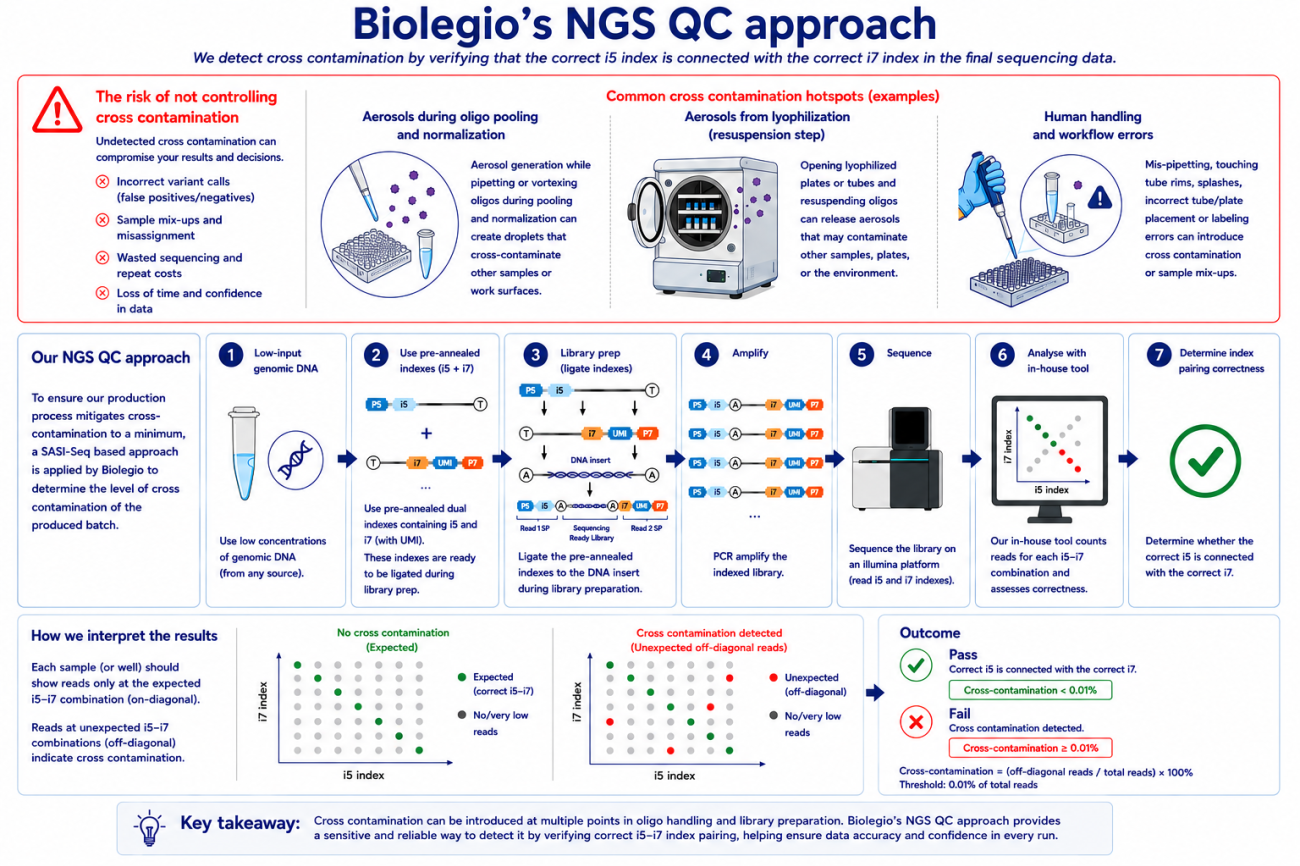
To address these challenges, Biolegio has redesigned its NGS oligo manufacturing workflow around contamination prevention and sequence purity. The company has invested in dedicated production infrastructure, enhanced manufacturing controls, automation, and NGS-based quality control methods capable of directly measuring cross-contamination at frequencies relevant to modern sequencing applications.
By combining stringent manufacturing processes with sequencing-based quality verification, Biolegio aims to provide researchers with greater confidence that the signals they detect originate from their samples rather than their reagents. As NGS technologies continue to advance, ensuring high levels of sequence purity is becoming an essential foundation for generating reliable and reproducible data
Download our full article or contact us to learn more